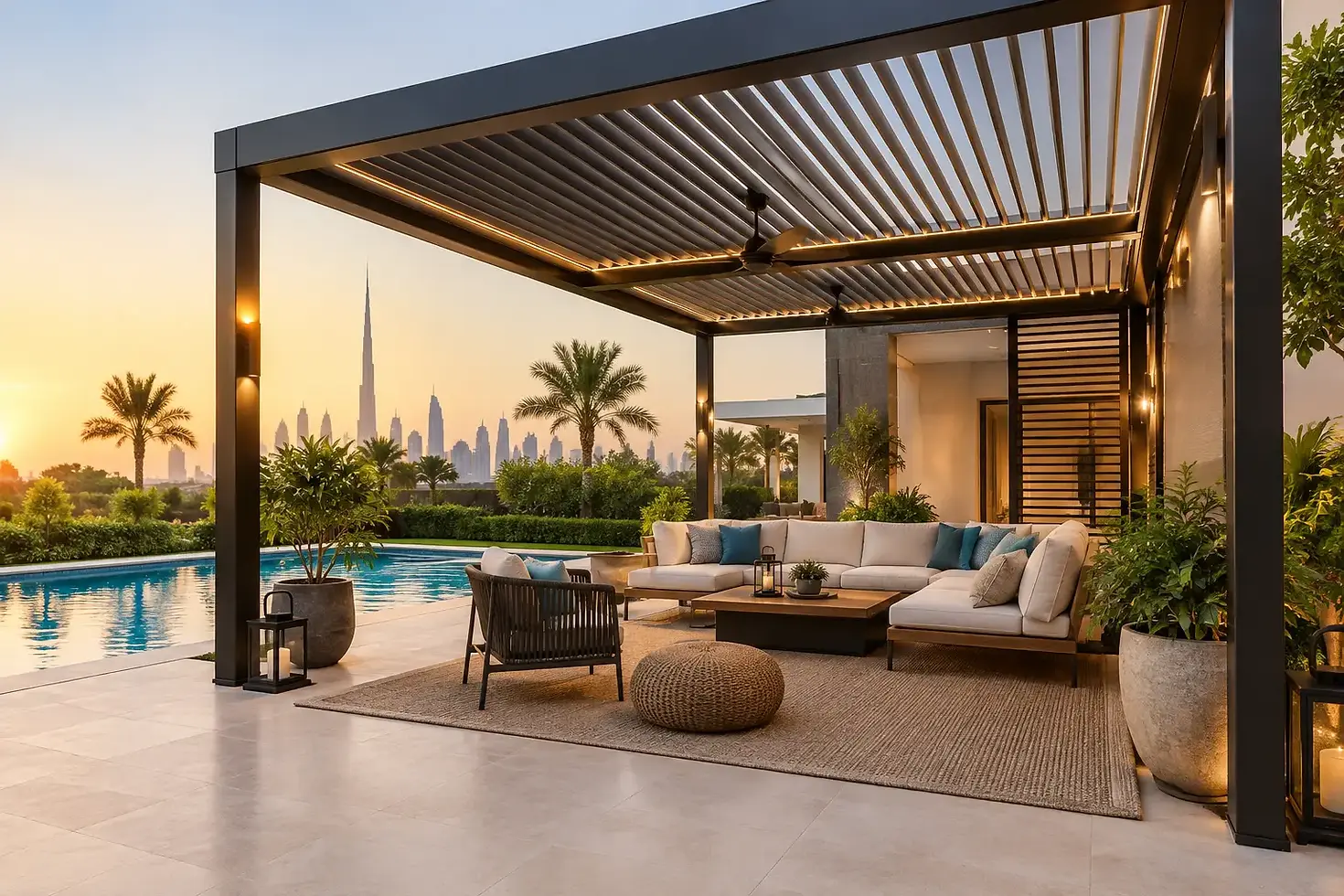
12 Pergola Accessory Ideas for Dubai Villas

A pergola becomes a genuinely valuable part of a Dubai villa when it does more than provide shade. The right pergola accessory ideas can turn an exposed patio into a composed setting for Friday lunches, children’s play, quiet morning coffee and evening entertaining - without asking the family to retreat indoors as soon as the sun, wind or humidity rises.
The most successful schemes are planned as one outdoor room rather than assembled one product at a time. Start with how you want to use the space, then select accessories that control sun, heat, privacy and airflow while complementing the architecture of your home.
Start with the conditions around your pergola
Dubai gardens place unusual demands on outdoor structures. Intense solar gain, airborne dust, occasional wind-driven rain and high summer humidity affect how every accessory performs. A feature that looks impressive in a showroom may be less useful if it is not specified for the pergola’s orientation, size and exposure.
A west-facing terrace, for example, usually benefits most from vertical shade and cooling. A garden facing neighbouring villas may require privacy without making the pergola feel enclosed. If the aim is year-round dining, rain management, lighting and a protected cooking zone should be considered from the outset.
This is why a site survey is valuable. It allows the pergola frame, drainage, electrical routes and accessory fixings to be coordinated before installation, rather than adding visible cables, mismatched brackets or costly alterations later.
Pergola accessory ideas that create a finished outdoor room
1. Motorised retractable louvred or fabric roofs
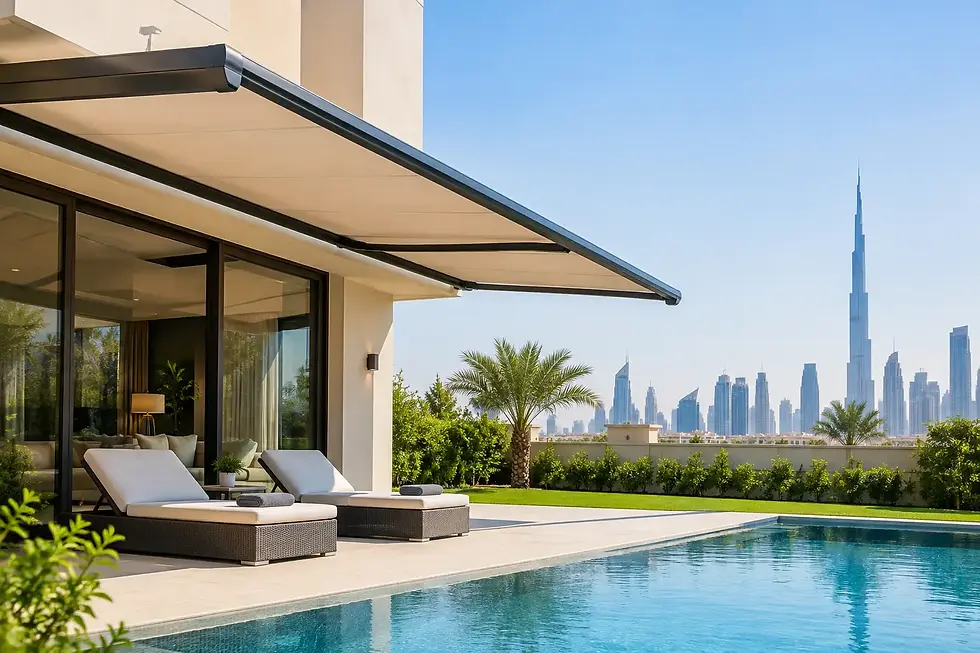
For homeowners who want flexibility, a motorised roof is often the defining upgrade. It allows the roof to open for natural light and cooler evening air, then close to create dependable shade or protection from rain. The best choice depends on the look required and the way the terrace is used.
Adjustable aluminium louvres offer a crisp architectural finish and precise control of daylight. Retractable fabric systems create a softer ceiling effect and can suit more traditional villa styles. In either case, the structural design, drainage details and motor quality matter as much as the visible roof surface.
2. Motorised zip blinds for low-angle sun
Overhead shade alone does not stop the late-afternoon sun entering from the side. Motorised zip blinds are one of the most practical pergola accessories for Dubai because they create a neat vertical screen when required and disappear into a discreet cassette when not in use.
Choose screen fabric when you want to reduce glare while retaining outward views and daylight. A denser or blackout material is better for privacy and stronger room-darkening performance, though it will naturally make the area feel more enclosed. Wind resistance should be assessed for each elevation rather than assumed from a standard product specification.
3. Sliding glass doors for all-season use
Sliding glass doors can make a covered pergola feel like a proper garden room while preserving the view of the pool, planting or skyline. They provide a barrier against dust, wind and rain, and they are particularly effective alongside zip blinds, which can still be used externally for solar control.
Glazing is not always the right answer. On a compact patio, too much glass can make the area feel constrained and may require more attention to cooling. However, for a larger dining terrace or an outdoor lounge used throughout the year, well-planned sliding panels bring welcome flexibility without the visual weight of conventional walls.
4. Integrated LED lighting
Lighting is often treated as a final detail, yet it determines whether a pergola is inviting after sunset. Recessed LED lights within the frame give clean, even illumination for dining, while dimmable circuits help the space shift from family dinner to relaxed entertaining.
A layered approach works best. Use practical light over a dining table or kitchen counter, then add softer perimeter lighting to define the edges of the terrace. Warm colour temperatures generally feel more comfortable in residential gardens than harsh white light. All wiring, transformers and access points should be planned before the structure is closed in.
5. Ceiling fans designed for covered outdoor areas
A well-positioned ceiling fan does not lower the air temperature, but it can make a shaded seating area considerably more comfortable by improving air movement. This is particularly useful during the shoulder months, when a fully enclosed and air-conditioned space may not be necessary.
Select a fan rated for sheltered outdoor use, with blades and fittings suited to humidity. Its position must be considered alongside roof operation, lighting and headroom. On lower pergolas, a compact fan or wall-mounted alternative may be more appropriate than a large statement fitting.
6. Misting and fogging systems for summer comfort
For open-sided pergolas, a professionally designed fogging or misting system can reduce the felt heat around seating and dining zones. Fine nozzles are positioned carefully so that the system cools the air without soaking furniture, flooring or guests.
The detail is in the design. Water quality, filtration, pump location and drainage all influence reliability. Misting is most effective in an open or partially open area; in a fully glazed space, it may add unwanted humidity. It should also be zoned, allowing homeowners to cool the dining area without running the whole system.
7. An outdoor kitchen that works with the layout
An outdoor kitchen changes a pergola from a place to sit into a place to host. A barbecue, sink, preparation surface, storage and refrigerator can be tailored to the way your household entertains, whether that means casual family grilling or larger weekend gatherings.
Kitchen positioning deserves careful thought. Keep smoke away from enclosed glazing and avoid placing the cooking zone where guests must pass behind the chef. Durable worktops, weather-resistant cabinetry and correctly planned gas, water and electrical services are essential. A refined outdoor kitchen should feel integrated with the pergola, not pushed against one side as an afterthought.
8. Furniture with the right scale and materials
The furniture defines how the space is used, but oversized sofas and excessive seating can quickly make a pergola feel crowded. Establish the primary purpose first: lounge seating, a formal dining table, a daybed area or a combination of two carefully separated zones.
Choose powder-coated aluminium, quality outdoor fabrics and quick-drying cushions that can withstand sun exposure and regular use. Lighter-coloured upholstery may look elegant but needs realistic expectations around maintenance, particularly near a pool or barbecue. Storage benches can be useful for cushions and children’s outdoor items without adding visual clutter.
9. Privacy screens and architectural panels
Fixed aluminium screens, timber-effect panels or laser-cut decorative inserts can provide privacy and create a stronger visual boundary. They are useful where a pergola overlooks neighbouring properties or where an unsightly service area needs to be softened.
The key is restraint. A single well-designed screen can frame a view and provide privacy without blocking every side. Combining a fixed panel on one elevation with motorised blinds on another often gives a more adaptable result than enclosing the entire structure.
10. Planters and planting for softness
Aluminium pergolas have clean lines, and planting prevents them from feeling overly hard against a villa façade. Large planters with heat-tolerant species can frame entrances, define a dining zone or provide gentle screening around the perimeter.
Avoid relying on climbing plants as the main source of shade. They take time to establish, need ongoing maintenance and may interfere with moving roof components if not managed carefully. Use greenery as a complement to engineered shade, not as a replacement for it.
11. Integrated drainage and flooring details
Neither feature is glamorous, but both protect the investment. A roof that channels rainwater correctly, with downpipes concealed within the pergola columns where possible, keeps the terrace cleaner and avoids awkward runoff at door thresholds.
Flooring should be selected for heat, slip resistance and drainage. Porcelain, natural stone and quality composite decking each have different visual and thermal properties. The best option depends on existing levels, the pool relationship and how much direct sun reaches the surface.
12. Discreet technology for easier entertaining
Outdoor speakers, concealed power sockets, television points and smart controls can make the space easier to enjoy, provided they are planned with discipline. Technology should support the atmosphere, not dominate it. Consider what the family will use weekly rather than specifying every available feature.
Centralised controls are especially useful when a pergola includes a motorised roof, blinds, lighting, fans and misting. Being able to adjust the setting quickly is valuable when the weather changes or guests arrive.
How to choose the right combination
The strongest pergola schemes usually combine a small number of high-performing accessories rather than every possible add-on. For an open poolside lounge, a retractable roof, zip blinds, fan and layered lighting may be enough. For a dining and entertaining terrace, glazing, an outdoor kitchen and integrated lighting may offer greater long-term value.
Euro Pergola Studio approaches these decisions as a coordinated design and installation project, considering the structure, accessories and finishes together. This gives homeowners clearer guidance on material performance, visual proportions and costs before work begins.
A beautiful pergola should make family life outside feel effortless. Begin with the moments you want the space to hold, then choose accessories that make those moments comfortable in every season.

Comments